Cost & Payback Guide
Solar Panel Cost in BC — Prices, Rebates & Payback
What a system actually costs in British Columbia, what it produces, and how long it takes to pay for itself. Written for North Okanagan properties, with the assumptions stated.
The Short Answer
The cost of solar panels in BC runs from about $9,500 for a small 4 kW system to around $30,000 for a large 10 kW-plus installation. Most family homes land between $14,000 and $24,000 installed.
That is the honest range. Anything narrower is either a sales hook or a quote for one specific house, and neither helps you work out what your own roof will cost. Below is what drives the number up or down, what the system will produce in this part of the province, and how the payback arithmetic actually works.
Call 250-250-2525 if you would rather skip to a figure for your address — it takes about fifteen minutes.

What Solar Panels Cost in BC by System Size
Installed cost in British Columbia currently works out to roughly $2.40 to $3.00 per watt for residential grid-tied systems, hardware and labour together. That gives you:
| System size | Suits | Installed cost | Est. annual output | Est. annual saving |
|---|---|---|---|---|
| 4 kW | Small home, low consumption, or partial offset | from $9,500 – $12,000 | ~4,400 kWh | ~$600 |
| 6 kW | 1,500–2,000 sq ft home | from $14,000 – $18,000 | ~6,600 kWh | ~$900 |
| 8 kW | 2,000–2,800 sq ft home | from $18,500 – $24,000 | ~8,800 kWh | ~$1,200 |
| 10 kW+ | Large home, heat pump, or EV charging | from $23,000 – $30,000 | ~11,000 kWh+ | ~$1,500+ |
Output estimates assume a well-oriented, largely unshaded array in the North Okanagan. Savings are calculated against current BC Hydro residential rates and will change as those rates change. Financing is available — ask about monthly options.
Why the per-watt figure matters more than the sticker price
A 4 kW system is not half the work of an 8 kW system — the scaffolding, the electrical work, the permit and the inverter are much the same. That is why cost per watt drops as systems get larger, and why the cheapest system is rarely the best value. If your consumption justifies 8 kW, buying 4 kW to save money usually means paying more per unit of power for the rest of the system’s life.
How BC Hydro Net Metering Works
Net metering is the mechanism that makes solar viable in British Columbia, and it is worth understanding before you look at any quote.
Your system is connected on your side of the meter. When the panels generate more than the house is consuming — which in the Okanagan means most of a summer afternoon — the surplus flows out onto the grid and BC Hydro credits your account at the retail rate. When your panels are producing nothing, at night or under February cloud, you draw from the grid as normal and those credits offset the draw.
Three things follow from that, and they drive every sizing decision we make.
Credits carry forward
A summer surplus is not wasted; it builds a balance that draws down through winter. This is what lets a system work at 50° north, where production between May and September dwarfs production between November and February.
Generating far beyond your consumption does not pay
Because the economics are built on offsetting power you would otherwise buy, a system sized well past your annual usage has nothing left to offset. This is the single most common way people overspend on solar — covering the whole roof because the roof is there.
Your annual consumption is the design input, not your roof area
We size against twelve months of your actual BC Hydro usage. It is the first thing we ask for and the reason our estimate takes a day rather than a minute.
Program terms are set by BC Hydro
Interconnection requirements, application steps and program terms do change. We handle the net-metering application as part of the install and confirm current terms at the time of your estimate rather than quoting something that may have moved.
Are Solar Panels Worth It in BC?
Sometimes clearly yes, sometimes clearly no, and the deciding factor is almost always how much electricity you use.
Solar tends to be worth it when:
- You use a lot of power — heat pump, electric vehicle, hot tub, workshop, large home. Every kilowatt-hour you generate offsets one you would have bought, so high consumption converts directly into faster payback.
- Your roof faces somewhere between southeast and southwest, with a pitch in the normal range.
- You have little or no shade across the array between roughly 9am and 4pm.
- You plan to stay put, or you are in a market where a paid-off system reads as an asset to buyers.
- You are re-roofing anyway. Doing both at once saves a removal and reinstall later.
Solar is often not worth it when:
- Your bills are genuinely low. If you are paying $70 a month, there is not enough there to offset.
- Mature trees or a neighbouring building shade the roof through the middle of the day. Shade does disproportionate damage to output.
- The only usable roof plane faces north.
- The roof has under ten years left and you are not ready to replace it.
We will say so when it is the second list. It costs us a job and saves you a twenty-five-year disappointment, and enough people have thanked us for it that we have stopped treating it as a loss.
On payback: most well-sized North Okanagan residential systems fall in a twelve to eighteen year simple payback range at current rates, against panel warranties that typically run twenty-five years. That window shortens if power rates rise — which, over the life of a system, they have reliably done.
What Changes the Price on Your Property
Two houses on the same street routinely get quotes thousands apart. This is usually why.
Roof orientation
South is best. East and west typically cost you somewhere in the region of 15–20% of annual output versus south, which does not kill a project but does change the payback. North-facing planes are generally not worth panelling.
Roof pitch
Standard residential pitches work well here. Very shallow roofs collect dust and need more cleaning; very steep roofs add labour and fall-protection cost.
Shade
The most underestimated factor by a wide margin. A single tree clipping the array for two hours in the afternoon can cost more output than people expect, because of how strings behave under partial shade. It is often fixable with panel-level optimisers, at some cost.
Your electrical panel
Older Vernon homes — a lot of East Hill and BX housing stock — sometimes need a service upgrade before a system can be connected. Budget $2,000 to $4,000 if yours does. We check this early rather than discovering it at install.
Roof material and condition
Asphalt shingle is straightforward. Metal is straightforward and often better. Tile, cedar and older membrane roofs cost more to work on. A roof near the end of its life should be replaced first.
Mounting type
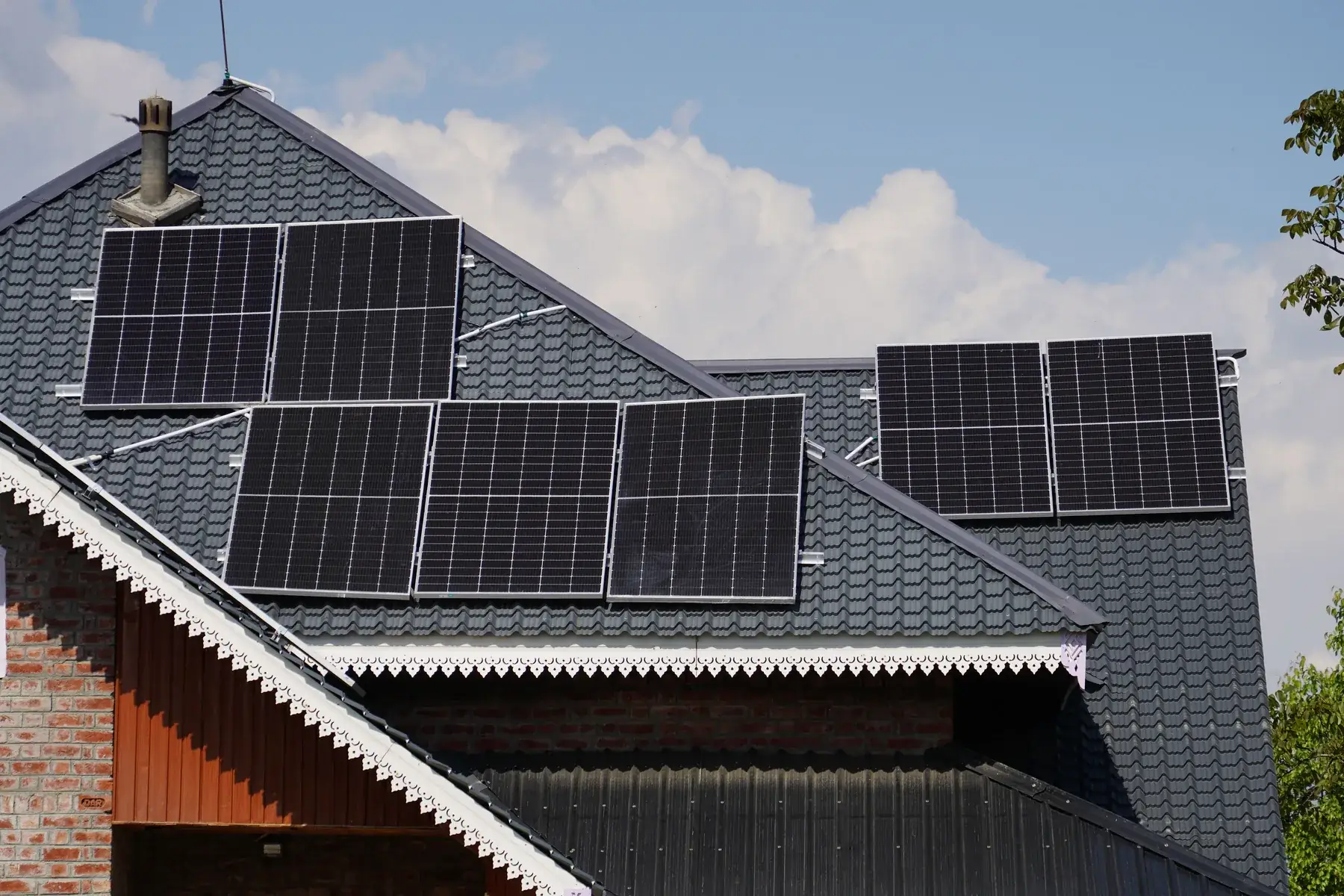
Roof-mount is the default. Ground-mount costs more per watt because of the racking and trenching, but it is the right answer on acreages with poor roof orientation and space to spare — common out through Spallumcheen, Lavington and the BX.
Snow load
Up at Silver Star and Predator Ridge, racking and attachment have to be specified for real alpine loading. That is an engineering requirement, not an upsell.
System size
Larger systems cost more in total but less per watt. Sizing follows your consumption, not your budget or your roof area.
Rebates and Financing in BC
Rebate programs in British Columbia change with some regularity — provincial and federal programs have opened, changed terms and closed several times over the past few years, and eligibility often depends on your utility, your property type and what else you are upgrading at the same time.
Rather than list programs that may have closed by the time you read this, we check what is current and applicable to your specific address as part of the free estimate. That includes any utility-administered offers, any federal program in effect, and financing options where a rebate is not available.
Financing is available for most residential installations. Terms depend on the lender and your circumstances, so we will walk through the monthly options at estimate stage rather than quoting a rate here that may not be the one you are offered.
Get a Figure for Your Own Property
Everything above is the general shape. Your number depends on your roof, your consumption and your electrical panel — and working it out properly takes us about a day once we have your usage history.
The estimate is free, it comes with the assumptions written down, and if the numbers do not work on your property we will tell you that instead.
Find out what solar would do for your power bill.
A free estimate takes about fifteen minutes on the phone. No pressure, no obligation, and a straight answer either way.